Tuesday, April 16, 2013

Don't Forget the Poncho by Scott Hejka


It is a Tuesday morning in Manhattan and Morgan is just waking up. After getting dressed, she runs down the stairs and into the small, well-lit kitchen. Her mother is already awake, making Morgan’s lunch. Morgan, noticeably excited to go to school, says “Good morning, mom! Did you make a sandwich for Poncho, too?”

“Poncho?” Morgan’s mother asked, raising one eyebrow slightly.

“Mom! You know who Poncho is. I told you about him last week. Remember the fish I found in the green, smelly pond on the way to school?” Morgan replies, troubled that her mother would not remember something so important.

Poncho is a small fish that lives in a filthy, contaminated pond near an abandoned chemical plant. Morgan passes by the green, vinegar-smelling pond on the way to school each day and feeds him a peanut-butter-and-jelly sandwich.

Confused, Morgan’s mother asks, “Why do you need a sandwich for a fish?”


Morgan answers, “Poncho controls the weather. He says that if I don’t give him a sandwich every day, bad things will happen.”

“Honey, you know fish can’t talk. And nobody can control the weather,” says her mother.

Morgan defiantly says, “But Poncho can, Mom! I swear!”

Morgan’s mother, not in the mood to argue about imaginary friends, says “Fine, honey. Take this tuna sandwich for Pontoon.”

Morgan gasps and makes a face as if someone is stabbing her in the spleen. “His name is Poncho and I can’t feed him tuna! Do you know what tuna is?

It took all the effort Morgan’s mother could muster to keep from laughing at her cute mispronunciation of such a bizarre word for a girl her age to know. She says, “Honey, settle down. It’ll be fine. Besides, that’s all we have right now.”

Morgan, after much argument with her mother, begrudgingly takes the sandwich and puts it in her lunch bag. She puts her backpack on, says goodbye to her mom, and skips along to school. On the way to school, Morgan stops by a green pond that is bubbling and smells like vinegar. She takes out the tuna sandwich and yells “Poncho, come here,” and immediately a small purple-and-orange fish swims to the surface. Morgan throws the sandwich in the pond and watches it fizz while the fish nibbles at it. Then, all of a sudden, the area around the fish goes up in flames and a cloud of black smoke comes out of its skin, turning it jet black. In a deep, demonic voice that reverberates as if many people are speaking at once, the fish yells, “What is this? How dare you give me fish!

Right then, bubbles appear all over the fish’s skin. As they pop, tiny white fish with razor-sharp teeth fall out into the water and begin to flop into the nearest sewer drains. While all of this is happening, the sky turns green and fiery tornadoes burst from the ground. The clouds completely block out the sun over Manhattan Island, lit only by the constant lightning bolts and meteorite impacts. All over the city, the tiny white fish are speeding through the sewage system, jumping out of faucets, toilets, and drains and attacking anything they see. Morgan runs home and sees her house, amazingly, still standing, while all of the other houses in the neighborhood are smoldering piles of debris.

Morgan runs into her house, hysterical with fear, and yells, “Mom! Where are you?” The last place she looks is the bathroom. When she looks in, she finds her mother lying on the floor in a puddle of blood and surrounded by the tiny white fish that she saw come out of Poncho’s skin. The fish are bloated with the blood that they just ate, and are arranged in such a way that spells out the words “Don’t forget.

One week later, after the odd weather has ended, news and rescue crews come to Manhattan to witness the aftermath. What they find shocks them: Almost every structure in sight is a charred pile of debris, and what they find inside the remaining homes is the worst shock of all. Wherever they find sinks, drinking fountains, showers, bathtubs, or toilets, there are bodies lying in pools of blood. Further analysis shows that all of their organs are missing, and the flesh remaining has bite marks all over it. When they look through the sewage system, they find dozens of tiny white fish with razor sharp teeth. Finally, they come to the section of the island that Morgan lives in, where they find a small structure made from charred brick fragments and meteorites. Inside, they find Morgan, trembling, emaciated, and covered in her mother’s blood. The rescue team decides to evacuate the island of Manhattan and, since Morgan is the only survivor, take her away. Six months after the event, Morgan still screams in hysteria whenever she sees fishes or hears the word “Poncho.”

Images of Turkey by Frances FitzGerald


Writing Center Coordinator Frances FitzGerald and her husband, Tom Ward, traveled to Turkey in late February/early March. Following are a few of their photos.
Balloons in Cappadocia, Turkey
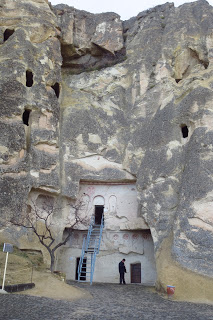
Cave Churches in Cappadocia
Evil Eye Tree in Cappadocia
Haggia Sophia in Istanbul
 

Blue Mosque, Istanbul


Pseudo-limerick by Fr. Ron DesRosiers


There was a young lady named Sally,

Who nurtured one lily-of-the-valley.

Folks thought her obsessive

And over-possessive.

That lily was Sally’s finale!


For Father Ron by Frances FitzGerald


Father Ron’s fond of the rose

Because it appeals to his nose

Though mums are okay

And take long to decay

The worth of a rose he well knows.


The Quentinville Quills by Sarah Kosel


The trouble with college writing groups is that they tend to get off topic. This proved to be the case with the Quentinville Quills, the renowned Quentinville University writing group, which met in a small room in the university’s cavernous library on the third Thursday of every month. It was facilitated by the head librarian, Ellesmera Jane, an eternal optimist who remained upbeat even in the face of the ever more obvious insanity running rampant among the young writers who showed up faithfully, notebooks clutched in their arms and ridiculous personalities clashing as soon as they tumbled through the door.


As the motley group found seats on one particular Thursday, chatting, laughing, and occasionally bickering in the process, Ellesmera stood by the doorway, trying to coax passing students into joining the group. After her initial attempts proved unsuccessful, the librarian switched tactics and began ambushing unsuspecting passersby, hauling them in by their ears and smiling sweetly as she tossed them into empty chairs. When everyone was settled and Ellesmera had locked the door in order to keep the most recent captives – that is, members – from escaping, the librarian took her seat at the head of the table and asked if anyone had brought something to read.


“Shouldn’t we introduce ourselves first?” queried a tall young woman with canary yellow pigtails and an ink smudge on her cheek. “There are some people here who aren’t our regulars,” she added, eyeing the students who were glancing at the door somewhat desperately. Ellesmera thought this was an excellent idea, and the yellow-haired girl began the round of introductions.


“Hello! I’m Rachel, a junior majoring in writing. I’ve been part of the Quentinville Quills since I started here.” The introductions continued with Zelda, Serendipity, and Hazelwood Lee, triplets whose long hair, bright eyeshadow, and patchwork skirts identified them as the resident hippies (all regulars). There was also Sylvester, a young man dressed in an old black suit coat and white dress shirt; Willard, a tall, lanky, and taciturn man who perched in a corner, rarely speaking; Zachariah Zebediah Zeeman III, who had such miniscule handwriting he had to carry around a magnifying glass in order to decipher it; and finally Charlie, who had the appearance of someone who had recently been electrocuted, his hair sticking out in all directions, eyes wide, and sporting a perennially dazed expression.


“Delighted to meet you all,” Ellesmera said cheerfully. “It’s nice to have such a large group. This is rather unusual!” The students who had been dragged in against their will exchanged looks of incredulity but remained silent. As Ellesmera waited expectantly, Willard stood up and began, with no prelude, to read in a dolorous baritone:


“How my heart walloweth in tremulous depths of woe,

For you dwell with the angels and you shall never bestow your grace to me,

a mere mortal.

Whilst I linger in agony your world turns just the same.

You are a planet, and I your moon,

drawn in by your gravity,

caught in a separate orbit,

never able to cross your path, forever apart.

Lost in the winding torment of my own soul

until you deign to grace me with your smile.”


Upon finishing, Willard abruptly sat down and did not utter another word for the rest of the afternoon. Ellesmera nodded politely and commented that it was a lovely piece, which everyone except Willard understood to mean, “I have no idea what any of that gibberish meant, but I commend you for putting pen to paper in an attempt to write.”


Deciding that some prose was in order, Serendipity cleared her throat, rustled her papers, and announced that she would read the first part of her fan fiction involving several characters from obscure British dramas. It was elaborate, eloquent, and so convoluted that by the end no one was exactly sure who had been shipped with whom, what canons had been involved, or whether in fact any pirates had made an appearance.


Zelda, who was not much for creative writing as she despised the frivolity, false reality, and, in her opinion, idiocy of the style, made it a habit of writing scathing reviews of her sister’s work. She especially despised anything to do with fandoms, and therefore, focused most of her energy on tearing Serendipity’s writing to pieces. Therefore, with the aid of many years of practice to assist her speedy drafting, Zelda had finished a scathing review of Serendipity’s fan fiction by the time the last line had been read. She cheerfully and loudly proclaimed to the group all of her criticisms, and then sat down, satisfied with her contribution.


At this point, Charlie, still looking somewhat dazed and confused, stood up with a crackle of electricity and offered to read his most recent story in an attempt to bring the meeting to happier ground. He described in impressive detail the destruction of the world in the near future by an alien race of zombies. Meanwhile, off to the side, Serendipity had accidentally-on-purpose spilled a thermos of boiling tea on Zelda, who was too busy trying to recover from the first-degree burns to pay much attention to Charlie’s delightful tale. Ellesmera, used to this turn of events, calmly handed over the burn cream and bandages she kept in her purse for occasions such as these.


Sylvester, having admired Serendipity for the length of the meeting, took this opportunity to lean over and tell her how, although he did not care for writing at all, he absolutely loved working out. He began to regale her with an in-depth explanation of the various exercises he preferred, undeterred by the glazed look on her face. When he mentioned that he was allergic to soy and was therefore unable to drink most of the protein shakes that otherwise might help him build muscle, Serendipity nonchalantly made a note of this fact. Unfortunately, Sylvester had never heard the advice that it is a bad idea to tell a woman what can kill you if you are aggravating her.


Hazelwood Lee, ignoring her sisters as she was used to their antagonism, timidly asked if the group would like to hear a few chapters from her novella. The few people who were still paying attention at this point nodded encouragingly, and were rather shocked when the story turned out to be an incredibly sarcastic memoir from the perspective of a serial killer. After Hazelwood Lee finished reading, Ellesmera complimented her on the vivid imaginativeness of piece and asked what her inspiration had been. An uneasy silence fell over the group when Hazelwood blithely replied that she tried to base all of her writing on personal experience.


At that point, Ellesmera decided the meeting should be adjourned, and opened the floor up for one last piece to be shared. Rachel, the yellow-haired writing major, volunteered to recite a limerick she had just written. Sitting up straight in her chair, she exclaimed:


“There once was a girl named Monday

Who loved a boy named Sunday.

They were set to be married

Until Sunday was buried

Before they could go on their way.”


Ellesmera – in fact, all of the regulars – were used to Rachel’s tragic stories, and so she received several compliments as she grinned in appreciation. Zachariah Zebediah Zeeman III pointed out that limericks were, by their very nature, supposed to be upbeat, but he was silenced by a warning look from Ellesmera and – when he ignored that – a swift kick from Willard.


Ellesmera graciously thanked everyone for attending, reminded them that the next meeting would be held on the third Thursday of the following month, and unlocked the door so she could send her unruly writers on their merry – or not so merry – way.  Smiling to herself as the students exited the room, some running and some wandering, Ellesmera returned to her normal work day. She had always thought it was nice to have such a lively group of writers on campus, and she was proud to be the facilitator of the Quentinville Quills.   


Reaper by Robert Rusk


A man dressed in a black suit sits at the edge of a bed with his head in his right hand and a revolver in the other hand. He raises his head from his hand, his face red from crying for the better part of a week. He looks at his computer sitting on his desk across from the bed. On the computer screen is a picture of a nineteen-year-old girl. She has brown hair and blue eyes that shine. She has a smile that could melt any man’s heart. Alice. His Alice. His daughter. The way she looked before. Before she came home for spring break. Before she had a run-in with a group of boys who wanted to have “fun.” Before they pulled her out of the lake. Before they put her in the ground. 


The boys who did this will never see the inside of a prison cell. Not with their rich parents and the sheriff protecting them. No one will help him find justice for his Alice. Not cops or lawyers.  No one. The only thing he can do now is skip to the end to be with Alice and Jen. He takes the gun and puts it under his chin. He starts to pull the trigger when his computer makes a noise.


He looks at the screen and sees an instant message. He decides to answer it. Maybe tell the person on the other end to send the cops over so he isn’t left rotting for a week. When he reads the message, he can’t believe what it says.


I can make them pay.


“What?”


Another message appears.


I can make the men who took your daughter from you pay. All you have to do is say yes.


Another line appears.


One rule: You cannot kill yourself until after I’m done.


The man drops the gun.


What’s your answer?


The man types in “yes.” A picture of a skull and two scythes around it appears on the screen.


Outside of town, on the only road into town, a black Impala drives along the lonely road.


Stop Me If You've Heard this One by Jesse Flanagan


The dust settles in,

Stop me if you’ve heard this one.

Who knows if the battle was lost or won?

The battlefield is scarred with words like “hate” and “bigotry”

And marked with mottos like “life” and “traditional family.”

And still, somewhere, the war rages on

And the victim lies, forgotten.

Humanity.

A thousand feet pound the ground,

Stop me if you’ve heard this one.

Everyone is right and the people stand divided.

And they are the true casualties here,

As they have forgotten how to make amends.

Peace is heaved into the flames and burned in effigy,

And the lost will wander with determination.